Showing posts with label Germany. Show all posts
Tuesday
The coronavirus cancels Oktoberfest in Germany
BERLIN — This year’s Oktoberfest in Munich has been called off because of the coronavirus pandemic.
The cancellation of the world-famous annual celebration of beer, which was supposed to run from September 19 to October 4, underlines expectations that the way back to normal life will be very long.
The Oktoberfest typically draws about 6 million visitors every year to the packed festival grounds in Bavaria’s capital.
Bavarian governor Markus Soeder said after meeting Munich’s mayor Tuesday: “We agreed that the risk is simply too high.” He added that “you can neither keep your distance nor work with facial protection” at the Oktoberfest.
Soeder noted that the festival attracts visitors from around the world, raising concerns about bringing new infections to Bavaria.
Mayor Dieter Reiter said that “it is an emotionally difficult moment and of course it is also an economically difficult moment for our city.”
As it stands, major events with large audiences are banned in Germany until at least the end of August.
The country has taken the first steps toward loosening its shutdown, allowing small nonessential shops to start opening this week, but it remains unclear when bars and restaurants will be able to welcome customers again.
The Oktoberfest has previously been canceled during the two world wars; at a time of hyperinflation in Germany in 1923; and because of cholera outbreaks in 1854 and 1873, German news agency dpa reported.
Associated Press
Labels:
2019 nCoV,
Beer,
Coronavirus,
COVID-19,
Festival,
Germany,
Novel Coronavirus,
Oktoberfest,
Outbreak,
Pandemic,
Virus,
World News
Saturday
European Leagues urge UEFA to make Champions League fairer
FRANKFURT, Germany — The European Leagues group has urged UEFA to allocate club competition entries and billions in Champions League prize money more fairly.
The proposal on Friday includes reversing changes made this season giving four guaranteed Champions League entries to Spain, England, Italy, and Germany, plus more guaranteed prize money to storied clubs with European titles dating back decades.
The 28-nation leagues group wants its ideas to feed into UEFA plans for a new competition in 2021.
UEFA has suggested 32-team group stages in the Champions League, Europa League, and an unnamed third event.
European Leagues says fairer shares of prize money and solidarity payments are needed to help competitions stay competitive.
Leagues also want weekends protected for domestic competitions, prohibiting Champions League games except the Saturday final.
source: sports.inquirer.net
Labels:
Champions League,
England,
European Leagues,
Football,
Germany,
Italy,
Spain,
Sports,
UEFA
Thursday
Trump rattles NATO, knocking its value, assailing Germany
BRUSSELS — Under fire for his warm embrace of Russia’s Vladimir Putin, President Donald Trump jolted the NATO summit Wednesday by turning a spotlight on Germany’s ties to Russia and openly questioning the value of the military alliance that has defined American foreign policy for decades.
Trump declared that a joint natural gas pipeline venture with Moscow has left Angela Merkel’s government “totally controlled” and “captive to Russia.” So, in a stroke, he shifted attention away from his own ties to the Kremlin just days before he meets one-on-one with Putin.
With scorching language, the president questioned the necessity of the alliance that formed a bulwark against Soviet aggression, tweeting after a day of contentious meetings: “What good is NATO if Germany is paying Russia billions of dollars for gas and energy?”
German Chancellor Merkel hit back immediately, not only denying Trump’s contention but suggesting that his comfortable upbringing in the U.S. gave him no standing to spout off on the world stage about Germany.
Drawing on her own background growing up in communist East Germany behind the Iron Curtain, she said:
“I’ve experienced myself a part of Germany controlled by the Soviet Union, and I’m very happy today that we are united in freedom as the Federal Republic of Germany and can thus say that we can determine our own policies and make our own decisions and that’s very good.”
Trump demanded by public tweet that members of the North Atlantic Treaty Organization “must pay 2% of GDP IMMEDIATELY, not by 2025” for their military efforts. He then rattled U.S. allies further by privately suggesting member nations should spend 4 percent of their gross domestic product on the military — more than even the United States currently pays, according to NATO statistics.
It was just the latest in Trump’s demands and insults that critics fear will undermine a decades-old alliance launched to counter-balance Soviet aggression after World War II. And it came just days before Trump planned to sit down with Putin in Finland at the conclusion of what has become a contentious European trip.
Trump has spent weeks berating members of the alliance for failing to increase military spending, accusing Europe of freeloading off the U.S. and even raising doubts about whether he would come to members’ defense as required if they were ever attacked.
Trump’s tongue-lashing accelerated during a pre-summit breakfast, when he traded his usual long-distance Twitter attacks for a face-to-face confrontation with NATO Secretary-General Jens Stoltenberg.
“We’re supposed to protect you against Russia but they’re paying billions of dollars to Russia and I think that’s very inappropriate,” Trump said, repeatedly describing Germany as “captive to Russia” because of the energy deal. He urged NATO to look into the issue.
Trump’s harsh words for Merkel, whose country has hosted tens of thousands of U.S. troops that have been key to post-WWII stability in Europe for seven decades, struck at the core of the alliance. West Germany joined NATO in 1955 and was a critical factor in the alliance’s success in facing down the Soviet Union until its collapse. Reunified with the East, Germany became the largest European economy in NATO in 1990.
The president’s beef was with the Nord Stream 2 pipeline that would bring gas from Russia to Germany’s northeastern Baltic coast, bypassing Eastern European nations like Poland and Ukraine and doubling the amount of gas Russia can send directly to Germany. The vast undersea pipeline is opposed by the U.S. and some other EU members, who warn it could give Moscow greater leverage over Western Europe. It’s expected to be online at the end of 2019.
Environmental-conscious Germany is trying to reduce its reliance on coal and is phasing out nuclear power by 2022, so it hopes to use natural gas to partially fill the gap until the country’s electricity grid can cope with fluctuating levels provided by renewable energy.
Hours after the breakfast, Merkel and Trump appeared to play nice as they met along the summit’s sidelines. Trump told reporters the two had a “very, very good relationship” and congratulated Merkel on her “tremendous success.”
While Trump went after Germany for its ties to Russia, he himself has been accused by critics of being too eager to improve relations with Moscow. He’s also dismissed the U.S. intelligence community’s assessment that Russia tried to undermine Western democracy by meddling in the 2016 U.S. presidential election to help him win.
Trump also lobbed fresh complaints about allies’ “delinquent” defense spending and suggested at one point that NATO allies commit to spending 4 percent of their GDP on defense — twice the goal they’ve set for 2024.
“I have great confidence they’ll be spending more,” he said.
However, a formal summit declaration issued by the NATO leaders Wednesday reaffirmed their “unwavering commitment” to the 2 percent pledge set in 2014 and made no reference to any effort to go higher.
Trump has repeatedly mischaracterized the spending target, wrongly describing it as a fee that countries pay to NATO or the U.S. rather than their own military. NATO estimates that 15 members, or just over half, will meet the benchmark by 2024 based on current trends.
Back in the U.S., Democratic congressional leaders Nancy Pelosi and Chuck Schumer issued a joint statement describing Trump’s “brazen insults and denigration of one of America’s most steadfast allies, Germany,” as “an embarrassment.”
“His behavior this morning is another profoundly disturbing signal that the president is more loyal to President Putin than to our NATO allies,” they wrote.
Sen. Bob Corker, a Tennessee Republican, also criticized Trump’s rhetoric.
“I do believe everybody should get to 2 percent quickly, but the NATO alliance is something that’s very important to the United States and our citizenry, and things that are said to try and create instability, all that it does is strengthen Putin,” Corker said, describing concerns “about conciliatory things that could occur in Helsinki” when Trump sits down with the Russian president.
But Sen. Tom Cotton, R-Arkansas, a strong supporter of the president, said the pipeline issue strikes at the “heart of NATO unity.”
“The pipeline gets cheap Russian gas to Germany while bypassing smaller Eastern European nations, allowing Russia to pressure them while Germany is held harmless,” he tweeted, adding: “No amount of preening in Berlin will cover this nakedly selfish policy.” /muf
source: newsinfo.inquirer.net
Labels:
Angela Merkel,
Bob Corker,
Chuck Schumer,
Donald Trump,
GDP,
Germany,
Iron Curtain,
Jens Stoltenberg,
Kremlin,
Nancy Pelosi,
NATO,
NATO Summit,
Russia,
World News
Sunday
Kroos scores late to give Germany 2-1 win over Sweden
SOCHI, Russia — Toni Kroos scored in the fifth minute of stoppage time from outside the penalty area, and 10-man Germany rallied to beat Sweden 2-1 on Saturday to stay alive at the World Cup.
Kroos’ goal came off a set play after a foul in the closing minutes of stoppage time. Kroos tapped the ball to Marco Reus, who set it up for Kroos to curl the right-footed shot to the far post. Sweden goalkeeper Robin Olsen couldn’t get his hand on it.
Reus scored in the 48th minute to pull Germany even after Ola Toivonen’s goal in the 32nd put the Swedes in front. Germany finished with 10-men after Jerome Boateng was sent off following a second yellow card with about 10 minutes remaining.
Mexico has six points in Group F, while Germany and Sweden both have three entering their final matches.
source: sports.inquirer.net
Labels:
2018 World Cup,
FIFA World Cup,
Football,
Germany,
Marco Reus,
Sports,
Sweden,
Toni Kroos,
World Cup
Monday
Mexico shakes with excitement over Germany World Cup win
MEXICO CITY — Thousands of exuberant Mexican soccer fans took to the streets Sunday to cheer their national team’s long-shot win against Germany in Mexico’s first match of the 2018 World Cup soccer tournament.
The 1-0 stunner, with Hirving Lozano scoring the winning goal, has given Mexicans hope that their team might win the tournament for the first time ever. Mexico has competed in the FIFA World Cup since the sporting event kicked off in 1930. The highest it has ever advanced is to the quarter-finals, placing sixth in both 1986 and 1970.
Lozano’s goal set off such a commotion that seismic detectors in Mexico City registered a false earthquake, which the geological institute said may have been generated by “massive jumps” across the city. Spectators who had gathered to watch the match on a big TV screen in the central Zocalo square screamed with joy after the score.
After the match, throngs of fans dressed in green converged around the iconic Angel of Independence monument, bouncing with joy and waving the Mexican flag. Small groups chanted “Mexico” and “Yes we could!” Some broke into song, including the traditional Cielito Lindo tune best known for its “Ay, Ay, Ay, Ay” chorus. Car horns blared, whistles were blown and drums beat for hours after the match.
“We aspire to win a World Cup this time,” said Miguel Paez, a 31-year-old who donned a Mexican wrestling mask in the colors of the national flag as he celebrated on Mexico City’s main avenue, Paseo de la Reforma.
Paez described the game as a welcome distraction from Mexico’s upcoming July 1 presidential election. “Mexico needs a break. Mexico needs to shout,” he said, jumping up and down.
Some Twitter commentators and fans were quick to draw parallels between the Mexican team’s long odds ahead of the Germany match and the big lead in surveys enjoyed by leftist presidential candidate Andres Manuel Lopez Obrador, or AMLO.
“AMLO can be beat. The surveys are based on few people,” said Jose Antonio Bohon, a 51-year-old national team supporter on his way to the Angel.
The win has also helped Mexican fans move beyond the team’s recent indiscretions.
The Mexican squad entered the 2018 tournament under a cloud of scandal. The problems began last year when the US Treasury Department accused team captain Rafael Marquez of being a front man for a drug kingpin. The accusation cost Marquez sponsorships and called into question whether he would play in the tournament. Marquez took to the field toward the end of Sunday’s match against Germany, notching his fifth appearance in a World Cup.
Also, earlier in June, gossip magazine TVNotas reported that nine members of the Mexican squad indulged in an all-night party with 30 female escorts following their farewell match against Scotland in Mexico City. Commentators worried that family tensions could distract the players from their goal of winning World Cup matches.
“They’ve always done things like that,” 53-year-old fan Magdalena Martinez said Sunday of the partying Mexican players. “It wasn’t my boyfriend or my husband, so as long as they continue to play well, who cares.”
source: sports.inquirer.net
Labels:
FIFA World Cup,
Football,
Germany,
Mexico,
Sports,
World Cup,
World Cup 2018,
World Cup Results
Friday
Large area of Berlin center evacuated for WWII bomb disposal
BERLIN — Berlin police are evacuating thousands from a central area of the German capital and shutting down the main train station in preparation for the removal of an unexploded World War II bomb found during recent construction work.
Police said on Friday that some 10,000 residents and workers were being forced to leave a two-square-kilometer (almost a square mile) area, including the train station, for bomb experts to defuse the 500-kilogram (1,100-pound) British bomb dropped during the war.
German rail operator Deutsche Bahn said train stops at the busy station would end at 10 a.m. and 11:30 a.m. through traffic will also be shut down before experts begin their work. It was not clear how long it would take.
Even 73 years after the end of the war, such discoveries are common in major cities in Germany. /kga
source: newsinfo.inquirer.net
Labels:
Bomb,
Deutsche Bahn,
Germany,
World News,
World War II
Monday
Man reunited with car after forgetting where it was parked 20 years ago
Back in 1997, a man filed a report to the Frankfurt police claiming that his car was missing.
Twenty years later, city authorities found the vehicle in an old industrial building, according to The Independent.
As per report, the building was about to be demolished and the police needed to find the car’s owner.
It turned out that the man, now 76, had simply forgotten where he parked his car.
German newspaper Augsberger Allgemein reports that the police and the man’s daughter accompanied him to see the vehicle.
The car was no longer functional and needed to be scrapped. Hopefully, the man at least dodged some hefty parking fees. Niña V. Guno/JB
source: newsinfo.inquirer.net
Labels:
Augsberger Allgemein,
Car,
Cars,
Frankfurt,
Germany,
The Independent,
Vehicle,
World News
Merkel wins fourth term as far-right enters German parliament
BERLIN - Chancellor Angela Merkel's conservatives beat their rivals on Sunday to win her a fourth term in an election that will also bring a far-right party into Germany's parliament for the first time in more than half a century, exit polls showed.
After shock election results last year, from Britain's vote to leave the European Union to the election of US President Donald Trump, many look to Merkel to rally a bruised liberal Western order, tasking her with leading a post-Brexit Europe.
She must now form a coalition government - an arduous process that could take months as all potential partners are unsure whether they really want to share power with her.
Merkel's conservative bloc won 32.5 percent of the vote, making them the largest parliamentary group, an exit poll for broadcaster ARD indicated. However, that was down from 41.5 percent in the last election, in 2013.
Support for their closest rivals, the center-left Social Democrats (SPD) which are currently junior partners in a so-called "grand coalition" with Merkel, slumped to 20.0 percent - a new post-war low. The SPD ruled out a re-run of that tie-up.
The far-right Alternative for Germany (AfD) stunned the establishment by finishing third and entering parliament for the first time with 13.5 percent of the vote.
Merkel, Europe's longest serving leader, joins the late Helmut Kohl, her mentor who reunified Germany, and Konrad Adenauer, who led Germany's rebirth after World War Two, as the only post-war chancellors to win four national elections.
SPD deputy leader Manuela Schwesig said her party would now go into opposition. That would rule out a re-run of Merkel's existing alliance with the SPD.
An alternative coalition for Merkel would be a three-way tie-up with the liberal Free Democrats (FDP) and the ecologist Greens. That is a combination as yet untested at national level and known as the "Jamaica" option because the three parties' colors are those of the black-gold-green Jamaica national flag.
Both the FDP and the environmentalist Greens have played down the prospect of a Jamaica coalition, but as they have been out of government for four and 12 years respectively, they may be lured into an alliance by the prospect of power.
New era
Whatever the make-up of her coalition, Merkel, 63, faces four years of government in a fragmented parliament after the return of the FDP - unrepresented at national level for the last four years - and the arrival of the AfD.
Founded in 2013 by an anti-euro group of academics, the AfD has morphed into an anti-immigration party that has profited from Merkel's 2015 decision to leave German borders open to over 1 million migrants, most of them fleeing war in the Middle East.
The party's entry into the national parliament heralds the beginning of a new era in German politics that will see more robust debate and a departure from the steady, consensus-based approach that has marked the post-war period.
The other parties elected to the Bundestag all refuse to work with the AfD, which says it will press for Merkel to be "severely punished" for opening the door to refugees and migrants.
After the AfD hurt her conservatives in regional elections last year, Merkel, a pastor's daughter who grew up in Communist East Germany, wondered if she should run for re-election.
But with the migrant issue under control this year, she threw herself into a punishing campaign schedule, presenting herself as an anchor of stability in an uncertain world. — Reuters
Labels:
Angela Merkel,
ARD,
CDU,
Christian Democratic Union,
German Elections,
Germans,
Germany,
Merkel,
Politics,
World News
Sunday
2 dead 4 wounded in German nightclub shooting
A gunman opened fire at a packed nightclub in southern Germany early Sunday, killing one and wounding four before being shot by police, authorities said, ruling out a terror attack.
The 34-year-old man, identified as an Iraqi national, “was critically injured in a shootout with police officers as he left the disco, and later succumbed to his wounds in hospital,” police said in a statement.
“We’re not assuming that this is an act of terrorist violence,” police spokesman Fritz Bezikofer told rolling news channel NTV.
“The events in the disco and all the links are somewhat clearer and they actually rule out a terror background,” he said, adding that the gunman was not an asylum seeker and has been living in Germany for some time.
Another police source said he could have been motivated by personal relationship issues.
Officers began receiving emergency calls from terrified clubbers at around 4:30 am (0230 GMT) as the man began shooting in the nightclub heaving with “several hundred” people, said police.
One person was killed on the spot and three others seriously wounded in the club called “Grey”, located in an industrial zone in Constance, a city on the banks of the eponymous lake near the Swiss border.
Shortly after the gunman left the building, he was shot by police. One officer was also injured in the exchange of fire.
Terrified nightclubbers had either fled the building or found a place to hide, police said, adding that the danger was now over.
Helicopters were circling overhead and special forces were also deployed to secure the site.
‘Club was jam-packed’
A witness told national news agency DPA that the attacker was shooting randomly at clubbers around him.
“The club was jam-packed,” added the unnamed man, who said he had seen the attacker and fled quickly with his friends.
A bouncer at the site had sought to stop the attacker, but was himself injured by the man, local broadcaster SWR said, also reporting witnesses saying that the gunman was armed with an automatic pistol.
Police was unable to confirm the type of weapon used, but Bezikofer said it was “not just a pistol, the talk is of a long weapon or an automatic pistol”.
The shooting came just two days after Germany was shaken by a knife attack in the northern port city of Hamburg.
A 26-year-old Palestinian had killed one and injured six in an assault at a supermarket.
He was a known Islamist with psychological problems, and investigators say his motives remain unclear.
Germany has been on high alert about the threat of a jihadist attack, especially since last December’s truck rampage through a Berlin Christmas market that claimed 12 lives.
But it has also been hit by other assaults unrelated to the jihadist threat.
Among the deadliest in recent years is a Munich shopping mall rampage last June by 18-year-old German-Iranian man which left 10 people dead including the gunman himself.
source: newsinfo.inquirer.net
Labels:
Crime,
Disco,
Fritz Bezikofer,
German Nightclub,
Germany,
Grey,
Grey Konstanz,
Grey Nightclub,
Nightclub,
Nightclub Shooting,
NTV,
Shooting,
World News
Saturday
One dead, six wounded in Hamburg supermarket knife attack
HAMBURG, Germany—One person was killed and six others were injured on Friday when a failed asylum-seeker brandishing a knife attacked shoppers in a Hamburg supermarket, shouting “Allahu Akbar” before being overpowered by passers-by, police and officials said.
The attack had been motivated by “hate,” mayor Olaf Scholz said, although he stopped short of declaring it a terrorist incident.
“It makes me especially angry that the perpetrator appears to be a person who claimed protection in Germany and then turned his hate against us,” he said.
If confirmed as an Islamist attack, it would be the first in Germany since Tunisian Anis Amri drove a truck into crowds at a Berlin Christmas market on December 19, killing 12 and injuring 48.
Police said that the man was a 26-year-old born in the United Arab Emirates, but were unable to immediately confirm his nationality or identify the motive behind the violence.
News website Spiegel Online reported that the individual was named Ahmad A., who had arrived in Germany seeking asylum and had contact with the Islamist scene as well as a history of mental health problems and drug use.
The attacker had been scheduled to be deported, but the process had been held up as he lacked identity papers, Scholz said.
A police murder unit and a squad specializing in politically-motivated crime are investigating the attack.
High alert
Germany has been on high alert about the threat of a jihadist attack since Amri’s rampage in Berlin, for which the Islamic State group claimed responsibility.
Jihadists have also carried out a string of random assaults in European countries using knives.
Like the Hamburg attacker, Amri was a failed asylum seeker who could not be deported for lack of documents.
The similarity between the two cases risks reopening barely-healed wounds over Chancellor Angela Merkel’s decision to allow more than million migrants into Germany since 2015, with just two months to go until legislative elections in September.
“These criminals want to poison our free society with fear, but they will not succeed,” mayor Scholz said.
Improvised weapons
The attacker stabbed to death a 50-year-old man, believed to be a German citizen, and “struck out wildly” at others, wounding a woman and four men aged 19 to 64, police said.
Another 35-year-old man was hurt while overpowering the attacker in the street alongside other passers-by shortly after the killing.
“A crowd of about 30 people ran out of the supermarket. They yelled that someone had been stabbed… we saw a man go past with a big knife, like a butcher’s knife, in his hand,” eyewitness Ralf Woyna told Agence France-Presse (AFP).
Woyna had been sitting at a cafe opposite the entrance to the shop where the chase began.
“Two customers who also looked Middle Eastern took all the chairs from the cafe and ran after him. I lost sight of them for a minute and heard a shout of ‘Allahu Akbar’ in the distance, I knew it was an attack straight away,” he added.
An amateur mobile phone video published by news site Spiegel Online showed a handful of pursuers confronting the attacker, a bearded man wearing a T-shirt and jeans, amid dense city traffic.
They can be seen hurling chairs at him to keep him at a safe distance as he yells and brandishes the knife.
According to Spiegel Online, the 35-year-old man injured during the struggle was the one who finally forced the suspect to the ground, using a pole.
The witnesses slightly hurt the attacker while they were overpowering him, before handing him over to police.
Newspaper Bild published images of the man lying handcuffed on the ground and sitting in the back seat of a police car, a bloodied white bag pulled over his head.
source: newsinfo.inquirer.net
Labels:
Attack,
Extremism,
Germany,
Hamburg,
Hate Crime,
Jihadists,
Knife Attack,
Olaf Scholz,
Terrorism,
World News
Friday
5 injured in ax attack at German train station; 1 arrested
BERLIN — A man was arrested after injuring five people with an ax at the main train station in Duesseldorf, Germany in what appeared to be a random attack, police said Thursday (Friday, Manila time).
Officers were alerted about an attack shortly before 9 p.m. (2000 GMT), prompting a large-scale response.
“A person, probably armed with an ax, attacked people at random,” police said in a statement. “At least five people were injured, one of them very seriously.”
The suspected attacker was arrested after jumping off an overpass near the train station, the statement said. The man suffered serious injuries and was being treated in a hospital.
Police said an ax was recovered and officers were searching the area in and around the station, which was closed for the investigation. Police withdrew an earlier report that a second person had been arrested.
German authorities have heightened security measures following a series of attacks in public places over the past year.
In one attack last July, a 17-year-old Afghan asylum-seeker traveling on a train near Wuerzburg injured five people with an ax and a knife before being shot dead by police. The attack was later claimed by the Islamic State group.
Duesseldorf police said there was no clear indication yet of the motive for Thursday’s attack.
source: newsinfo.inquirer.net
Labels:
Ax Attack,
Axe Attack,
Duesseldorf,
Germany,
Train Attack,
Train Station,
Violence,
World News
Wednesday
SanDisk introduces 1TB memory card at Photokina 2016
One terabyte hard drives are nothing new and have actually started getting cheaper what with 4TB drives being made available. But a 1TB memory card is sure to catch anyone’s attention.
This monster capacity memory card was just announced Tuesday at Photokina in Cologne, Germany. Officially tagged as the SanDisk 1TB SDXC, it is a prototype memory card that was developed to address the growing trend of 4K and 8K resolution multimedia content.
Back in 2014, SanDisk also made headlines as it first introduced the 512GB SanDisk Extreme PRO SDXC UHS-I memory card, also at Photokina. It’s remarkable how the company has been able to double the capacity of its memory card in just a couple of years.
Apart from the storage of ultra-high-resolution multimedia, SanDisk also sees application of this high-capacity storage media in the growing virtual reality industry.
No word yet has been made available regarding price and availability, and it may still be a few months before the memory card becomes available in the market. Alfred Bayle
source: technology.inquirer.net
Labels:
Flash Memory,
Germany,
Photokina 2016,
SanDisk,
SanDisk 1TB SDXC,
Tech News,
Technology
Saturday
Police say Munich suspect was obsessed with mass shootings
MUNICH — The 18-year-old gunman who opened fire at a crowded Munich shopping mall and fast-food restaurant, killing nine people and wounding 16 others before killing himself, was obsessed with mass shootings, police said Saturday.
Investigators searched the unnamed German-Iranian man’s home overnight and found a considerable amount of literature about mass killings, including a book titled “Rampage in Head: Why Students Kill,” but no evidence that he was linked to extremist groups such as the Islamic State.
“(He) was obsessed with shooting rampages,” Munich’s police chief Hubertus Andrae told reporters.
Investigators also found evidence that the Munich-born suspect had suffered from psychological problems and received treatment, but details were still being confirmed, said Munich prosecutor Thomas Steinkraus-Koch.
The attack in the Bavarian capital sparked a massive security operation as authorities — already on edge after the recent attacks in Wuerzburg and Nice, France — received witness reports of multiple shooters carrying rifles shortly before 6 p.m. (1600 GMT). Eight hours later police declared a “cautious all clear,” saying the suspect was among the 10 dead and that he had likely acted alone.
German Chancellor Angela Merkel was due to chair a meeting of her government’s security Cabinet Saturday.
At an address on Dachauer Strasse that was searched by police early Saturday, a neighbor described the suspect as “very quiet.”
“He only ever said ‘hi’. His whole body language was of somebody who was very shy,” said Stephan, a coffee shop owner who would only give his first name.
“He never came in to the cafe,” he added. “He was just a neighbor and took out the trash but never talked.”
Some 2,300 police from across Germany and neighboring Austria were scrambled in response to the attack, which happened less than a week after a 17-year-old Afghan asylum-seeker wounded five people in an ax-and-knife rampage that started on a regional train near the Bavarian city of Wuerzburg. The Islamic State group claimed responsibility for the train attack, but authorities have said the teen — who was shot and killed by police — likely acted alone.
The suspect’s body was found about 2 1/2 hours after the attack, which started shortly before 6 p.m. (1600 GMT) at a McDonald’s restaurant across the street from the mall.
A cell-phone video posted online showed the suspect dressed in black standing on a rooftop parking area of the mall yelling back and forth with the person filming, saying at one point “I’m German” and eventually firing shots. Andrae said police believe the video is genuine.
David Akhavan, a 37-year-old who from Tehran, Iran, who works at the Shandiz Persian restaurant, described his anguish as he learned of the shooting.
“I started to get texts from friends asking if I was safe,” he said. “Then, my thoughts were: please, don’t be a Muslim. Please don’t be Middle Eastern. Please don’t be Afghan. I don’t accept any of this violence.”
Witnesses had reported seeing three men with firearms near the Olympia Einkaufszentrum mall, but Andrae said two other people who fled the area were investigated but had “nothing to do with the incident.”
Local residents described the scene as the shooting unfolded.
“I was standing on the balcony smoking a cigarette. Suddenly I heard shots,” said Ferdinand Bozorgzad, who lives in a high-rise building next to Olympic Shopping Center. “First I thought someone had thrown some firecrackers. I looked down at the McDonald*s and saw someone shooting into the crowd. Then I saw two people lying there. ”
Franco Augustini, another local resident, said his daughter hid in the shopping center during the attack.
“Next to our flat was a woman who was full of blood,” Augustini said. “My wife had a bottle of water. Then we helped to wash her. It was horrible and made me speechless.”
Andrae, the police chief, said seven of the victim were teenagers; a 20-year-old man and a 45-year-old woman were also killed. All were residents of Munich, he said.
Munich’s mayor, Dieter Reiter, declared a day of mourning for the victims of “this terrible act.”
“These are difficult hours for Munich,” he said, adding that the city’s citizens had shown great solidarity toward each other. “Our city stands united,” he said. TVJ
source: newsinfo.inquirer.net
Friday
Griezmann’s double gives France 2-0 win over Germany in semis
MARSEILLE, France—France is heading back to soccer’s elite, and Antoine Griezmann is the man leading the way.
Griezmann scored both goals to give France a 2-0 win over world champion Germany on Thursday and a place in the European Championship final against Portugal.
It was a victory built as much on German errors as it was on Griezmann’s skill, with a handball in the box and a poor defensive pass paving the way for his goals.
But that didn’t matter to the fans who made Marseille’s Stade Velodrome ring with the sound of the “Marseillaise,” France’s national anthem. Their team won this tournament in 2000, two years after lifting the World Cup, but it hasn’t had a trophy since then.
Developed as a player in Spain, Griezmann has been the star of the show for France, leading a high-scoring team with six goals, twice as many as any other player in the tournament.
“I think there’s a lot of happiness around France tonight,” said coach Didier Deschamps, whose team faces Cristiano Ronaldo’s Portugal on Sunday at the Stade de France.
“This team has everything it needs to be loved, I’m very proud… It’s fabulous to be in the final.”
Griezmann, who could have completed a hat trick in the 86th minute but shot straight at goalkeeper Manuel Neuer, was already looking ahead.
“We’re very happy,” he said. “We have to keep our feet on the ground. We still have a match to go.”
For Germany, defeat cost it the chance to add the European title to the World Cup it won in 2014.
It had gone 50 years unbeaten against host nations at major tournaments, dating back to its loss to England in the 1966 World Cup final and encompassing a famous 7-1 humbling of Brazil in the 2014 World Cup semifinals.
While a repeat of the Brazil rout was never on the cards, Germany could have scored more than once as it dominated the first half. But it was denied by poor shooting from Thomas Mueller, who ended his tournament scoreless, and a save by Hugo Lloris to block Emre Can’s bouncing shot.
France took the lead from the penalty spot in first half stoppage time after Bastian Schweinsteiger handled the ball in an aerial challenge with Patrice Evra.
Griezmann stepped up to score, striking the penalty hard to Neuer’s right.
“I really wanted to take a penalty in a big match like that. I was very composed, I didn’t think twice,” Griezmann said.
It was the second time in as many games that Germany had given away a spot-kick for handball. Jerome Boateng blocked the ball with an arm above his head in the quarterfinal against Italy.
“It’s just bad luck, just an unlucky action,” Germany coach Joachim Loew said of the penalty. “In a challenge, when you’re jumping, there are movements that you can’t really control.”
Trailing in a match for the first time in the tournament, Germany could not recover its previous dominance after halftime. It then had to cope with losing key defender Boateng, who picked up an ankle injury after an hour.
The German defense had not conceded from open play all tournament, but it fell apart for Griezmann’s second goal in the 72nd minute. A sluggish pass by Benedikt Hoewedes to right back Joshua Kimmich was cut out by Paul Pogba and Neuer could only palm away the midfielder’s cross to Griezmann, who finished with ease.
Germany responded well and could have pulled one back when Kimmich hit the post, before Julian Draxler sent a free-kick narrowly wide and Hoewedes headed over.
“We had chances to come back,” Neuer said. “We played a good European Championship and it’s very bitter to go out.”
Loew insisted his team had played better than France but had been denied by “bad luck,” including the injuries and suspensions that hit four key players – Boateng, as well as defender Mats Hummels, midfielder Sami Khedira and forward Mario Gomez, with the latter three missing the game.
Loew, who is under contract until the 2018 World Cup, said he was not sure of his future.
France, while not always reassuring in defense, came through victorious in its first game of the tournament against genuinely top-class opposition.
After the final whistle, France’s jubilant players celebrated with the fans by performing the “Huh” chant made famous at the tournament by Iceland.
Across France and in the French team, the attention was firmly on the diminutive Griezmann after another decisive performance. “He’s our little man that gives us that bit extra,” teammate Olivier Giroud said.
source: sports.inquirer.net
Labels:
Antoine Griezmann,
Euro 2016,
Football,
France,
Germany,
Olivier Giroud,
Soccer,
Sports,
UEFA Euro 2016
Sunday
Hector the hero as Germany sink Italy in shoot-out
Jonas Hector fired Germany into the Euro 2016 semi-finals at Italy’s expense after an epic round of 18 penalty kicks that saw players from both sides produce stunning misses in Bordeaux on Saturday.
World Cup holders Germany won the shoot-out 6-5 after a tense match finished 1-1 at the end of 90 minutes and extra time, beating old foes Italy at a major tournament for the first time in nine attempts.
Their reward is a semi-final with the winner of Sunday’s last quarter-final between hosts France and Iceland.
Joachim Loew’s side had appeared to be heading for the win after Mesut Ozil gave them a 65th-minute lead, but Italy equalized through a Leonardo Bonucci penalty 12 minutes from the end of normal time after a Jerome Boateng handball.
With no goals in extra time, Ozil, Thomas Mueller and Bastian Schweinsteiger all failed from the spot for Germany, usually so reliable from 12 yards.
But after Simone Zaza and Graziano Pelle missed for Italy and Bonucci was denied by Manuel Neuer, Matteo Darmian’s failure to convert the Azzurri’s ninth kick allowed Hector to become Germany’s hero.
“It’s hard to put it into words, but I am overjoyed that it went in,” said Hector.
“There weren’t many people left. I knew I had to take one at some point and I had my heart in my mouth. We’re happy to have gone a round further, it was really stressful and of course luck played its part.”
Italy’s campaign had shown promise with wins against Belgium and over Spain in the last 16, and coach Antonio Conte said: “I’m very proud of what the team achieved here.
“The only regret is the penalty kicks. But for commitment to the shirt, I can’t fault them.”
The game had been billed as the pick of the quarter-finals, but large spells of the game in Bordeaux were uneventful.
Germany talisman Schweinsteiger again started on the bench but was introduced after quarter of an hour to replace Sami Khedira, who came off with a groin injury.
Schweinsteiger found the net just before the half-hour mark but his effort was disallowed for a foul on Mattia De Sciglio.
Germany change approach
Loew had sprung a surprise by moving away from his usual 4-2-3-1 formation in favour of a 3-5-2 to replicate the Italian set-up, dropping the previously excellent Julian Draxler as a result.
Germany went on to dominate possession but Gianluigi Buffon was untroubled by a Mario Gomez toe-poke while the veteran goalkeeper also easily saved from a Mueller shot late in the first half.
Italy responded in kind, Emanuele Giaccherini seeing his cutback go all the way to Stefano Sturaro, whose low drive had power but was deflected behind for a corner.
Germany moved up a gear immediately after the restart, Gomez smartly laying the ball off for Mueller to hit a left-foot drive that was turned behind by the backtracking Alessandro Florenzi.
The opener arrived soon after as Gomez pounced on some slack defending by Florenzi before finding Hector in space to the left of the penalty box.
The full-back’s attempted cutback came off Bonucci but fell to Ozil, who fired past Buffon from close range to give Germany the lead.
They could have gone further ahead when Ozil found Gomez in space with a great chip, but Buffon superbly saved the striker’s outrageous flick from close in and the offside flag came up anyway.
Italy looked down, but they were not out.
An unmarked Pelle got his left foot to Florenzi’s low cross but fired off target, and minutes later the Azzurri pulled level after the ball came off the arm of Boateng in the area.
Hungarian referee Victor Kassai immediately pointed to the spot and Bonucci stepped up to beat Neuer low to the goalkeeper’s left to spark wild celebrations.
It was the first goal Neuer had conceded at the tournament after four successive clean sheets.
There was a minor scare for the Germans with three minutes left when Eder found De Sciglio on the left and the AC Milan midfielder saw his powerful drive ripple the side-netting.
Into extra time they went and Germany came closest in the additional half hour, substitute Draxler pouncing on a poor headed clearance from Andrea Barzagli to send an overhead kick just over, before both sides settled for penalties and the drama that ensued.
source: sports.inquirer.net
Saturday
Seine water levels decrease again after Paris flooding peaks
PARIS—French authorities say the water level of the Seine river in Paris is starting to decrease after reaching its peak overnight, the highest in nearly 35 years.
But authorities warned it could take up to ten days for the river to come back to its normal levels after the flooding that swelled the river to about 4.5 meters (15 feet) above average levels in Paris.
Floods due to heavy rains have inundated parts of France, Germany and Belgium this week.
Over 17,000 homes were still without electricity Saturday in the Paris region and center of France.
Authorities have also shut the Louvre museum, the national library, the Orsay museum and the Grand Palais, Paris’ striking glass-and-steel topped exhibition center.
source: newsinfo.inquirer.net
Labels:
Belgium,
Flooding,
France,
Germany,
Grand Palais,
Louvre Museum,
Musée d'Orsay,
Orsay Museum,
Paris,
River,
Seine River,
World News
Tuesday
Global winds chill business optimism in Europe
FRANKFURT, Germany — Business confidence fell in Germany and France this month, increasing concern that the global market turmoil may be weighing on the economy of the 19-member euro currency union.
Germany’s closely watched Ifo confidence index fell to 105.7 points in February from 107.3 last month, the third decline in a row. France’s INSEE index dropped to 100 points in February from 102 in January.
The data released Tuesday bolsters the argument for the European Central Bank to expand its monetary stimulus efforts at its next meeting March 10.
The central bank is currently pumping 60 billion euros ($66 billion) per month in freshly printed money into the financial system through bond purchases in an attempt to push up weak inflation and support a modest recovery. The eurozone grew 0.3 percent in the last three months of last year; unemployment remains high at 10.4 percent.
In Germany, the eurozone’s largest economy, business executives’ view of current conditions improved but their outlook for the next half-year worsened significantly.
Economist Carsten Brzeski at ING-DiBa called the reading a “wake-up call.”
“Global events have finally reached German companies’ boardrooms,” he wrote in an email research note.
The euro fell in currency markets, from around $1.1040 to under $1.10 before rebounding slightly.
The German survey indicated executives share worries about the global economy that have sent financial markets lower recently. China’s economy is slowing down, with unpredictable consequences for the rest of the world, while low oil and commodity prices have hit emerging market economies that supply much of the world’s growth these days. Financial market turmoil itself could have an impact by making businesses cautious about risking more investment in production.
The Ifo index is valued as a guide to where the economy is headed. The survey is based on monthly responses from about 7,000 firms.
Germany, the biggest economy in the 19-country euro currency union, is enjoying low unemployment of 4.5 percent and steady growth of 0.3 percent in the fourth quarter of last year. While exports have slowed, spending by consumers and the government has picked up.
The French confidence index slipped due to declining confidence among retailers. Manufacturing held up, suggesting global headwinds were not yet severely affecting the country’s gradual recovery.
Analyst Chantana Sam at HSBC Global Research said the fall in retail confidence could suggest that the impact from the terror attacks that left 130 people dead in November was lingering more than expected. Retail confidence remains below the level seen before the attacks.
Analysts say the ECB could try to help the economy by increasing its bond-buying stimulus program. It could also cut the interest rate on deposits it takes from commercial banks, currently minus 0.3 percent. The negative rate is a drastic step aimed at pushing banks to lend money rather than let it pile up at the central bank’s super-safe overnight deposit facility. The negative rate has also helped push the euro lower against other currencies, helping exporters. TVJ
source: business.inquirer.net
Monday
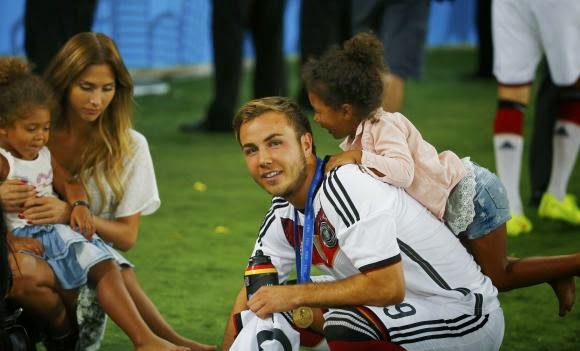
Goetze is Germany's wonder boy, says coach Loew
Germany forward Mario Goetze, who plundered the extra-time winner in the World Cup final against Argentina, is a wonder boy with immense qualities, coach Joachim Loew said on Sunday (Monday, PHL time).
Substitute Goetze, who until the final had had a disappointing tournament, struck the only goal seven minutes before the end of extra time to clinch Germany's fourth World Cup.
"I told him 'you go out there and show the world that you are better than (Argentina captain) Lionel Messi and that you can decide the game tonight'," Loew told reporters.
Four-times world player of the year Messi was looking for a first World Cup victory that would place him among the world's greatest players.
But Goetze stole the show.
"That's what I told him and I had a good feeling," said Loew, who brought on the attacking midfielder two minutes before the end of normal time for striker Miroslav Klose.
The 22-year-old paid back his coach's trust, volleying in his second goal of the tournament after spending the past few games on the bench.
"Goetze is a wonder boy who has these immense abilities, this outstanding skill," Loew said. "He can always decide a game and he scored a great goal today."
For man-of-the-match Goetze, it had not been an easy tournament after initially failing to live up to expectations.
One of Germany's most talented and promising players, he scored in the group game against Ghana but then was not used much.
"It was not an easy year, not an easy tournament for me," said the softly-spoken Goetze.
"But I am just happy that the team won this title with me. I kept training with the team and every player here deserves it," said Goetze. - Reuters
source: gmanetwork.com
World Cup: Germany not expecting any more Argentine gifts
Germany have been given a helping hand by opponents Argentina in beating them at the last two World Cups but they do not expect any more South American gifts in Sunday's (Monday, PHL time) final at the Maracana.
Their 2006 quarter-final win came after Argentina took a second-half lead but then replaced playmaker Juan Roman Riquelme with the more defensive Esteban Cambiasso while Lionel Messi was kept on the bench.
Germany seized the initiative, drew level and then won on penalties amid huge criticism of Argentina coach Jose Pekerman.
Four years ago, Germany took advantage of Diego Maradona's coaching naivety and cavalier approach as they tore the Argentines apart 4-0 again in the last eight.
Germany coach Joachim Loew and his opposite number Alejandro Sabella agree that Argentina have progressed since then.
"Our team is more conservative than four years ago, we are looking to triumph via a different path," Sabella told reporters on Saturday. "The teams are different although most of the players are the same.
"We'll give our all as always, with sacrifice, humility, hard work, being down to earth, giving before receiving, protecting one another, so that Argentina can be a champion again. We will do our best. More than that we cannot do."
ATTACKING POWERS
Loew said that Argentina were much more than Messi.
"They have other attacking powers like Sergio Aguero, Angel Di Maria. This team does not live solely on Messi. They have a good compact organisation, better than in 2010," he said.
"They can pressure opponents with their first line of attack early on, but they also sometimes fall back, and what is also one of their strengths - through defending and ball possession they bring Messi, Di Maria and Aguero quickly into the game."
"They can be behind the ball with eight or nine and then launch quick attacks."
Germany will be trying to win the World Cup for the fourth time, and also become the first European team to win the title in South America, while Argentina are aiming for a third crown.
The teams have already met in two finals with Argentina winning in 1986 and Germany getting revenge four years later.
Despite being among the most successful sides in their respective continents, neither team has won a trophy recently.
Germany's last success was at Euro 96 in England while Argentina won the 1993 Copa America in Ecuador.
Germany are favorites, having hammered Portugal 4-0 in the group stage and Brazil 7-1 in the last four, while Argentina managed five successive single-goal wins before edging past the Netherlands on penalties in Wednesday's semi-final. - Reuters
source: gmanetwork.com
Labels:
2014 FIFA World Cup,
Argentina,
FIFA World Cup,
Football,
Germany,
Sports,
World Cup
Germany to beef up spy defenses against allies – report
BERLIN - Germany plans to beef up its counterintelligence tactics against allied countries in response to revelations of widespread US spying, Der Spiegel magazine reported Sunday.
The weekly said the German government was considering deploying its own agents to keep tabs on Western secret services and embassies on German soil including those of the United States and also Britain.
It said the domestic intelligence service aimed to glean precise information about foreign spies using diplomatic cover and technical equipment at diplomatic missions used to snoop on German officials and the country's citizens.
"This step would be an about-face from the decades-long practice of systematically monitoring the activities of countries such as China, Russia and North Korea but rarely the activities of Western partners," Spiegel said.
It said the plans would require the final approval of Merkel's office as well as the foreign and interior ministries.
The reported initiatives follow leaks by former National Security Agency (NSA) contractor Edward Snowden that US intelligence agencies had eavesdropped on Chancellor Angela Merkel's mobile phone and collected vast amounts of online data and telephone records from average citizens.
Media reports last year said that equipment installed on the roofs of the US and British embassies in central Berlin was used for snooping.
Spiegel also reports in its upcoming issue on a suspected attack by Chinese spies on the German government ahead of the G20 summit in Saint Petersburg, Russia last September.
It said high-ranking German officials from several ministries as well as banks had been sent Chinese cyber-espionage malware under the guise of an exchange of information among economic advisors to the G20 governments.
A government spokeswoman told Spiegel that the attempt "to compromise information security at the chancellor's office" had been successfully rebuffed.
Merkel said Saturday ahead of a summit with French President Francois Hollande that they would discuss bolstering citizens' data protection with "European communication networks" that bypass US Internet giants. — Agence France-Presse
source: gmanetwork.com
Subscribe to:
Posts (Atom)