Showing posts with label Jeff Bezos. Show all posts

Sunday

Amazon is big … really, really big; workforce hits 500K


NEW YORK — Need more proof that Amazon is big? It came this week.

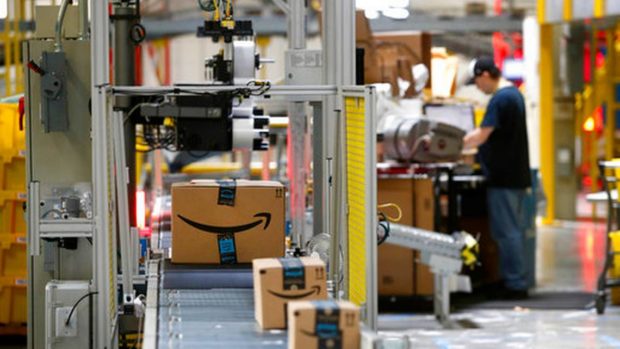
Amazon’s U.S. workforce has topped 500,000 for the first time, up 43% from the year before and more than triple what it was five years ago, the company said Friday. It gained 150,000 workers last year, more than the size of Apple’s entire workforce.


When it reported its quarterly performance Thursday , Amazon revealed that 150 million people were paying to be members of its Prime service, which offers faster shipping and other perks. On Friday, even while the Dow fell 600 points, Amazon shares soared passed $2,000 apiece, doubling in price in about two years.

Amazon’s growth comes with increased scrutiny. Some Democratic presidential candidates want to break it up. Others want it to pay more taxes. It is a regular target of President Donald Trump, who has been tweeting similar complaints as he fights with Amazon founder Jeff Bezos, who also owns The Washington Post. Amazon has said it shouldn’t be broken up, and that it pays all the taxes it owes.

Being under the microscope has not slowed its phenomenal growth. Sales during the holiday season soared. Its other businesses, including cloud computing and advertising, grew, too, despite increased competition from other big tech companies.

Analysts at Benchmark said the results were a “not-so-subtle reminder Amazon is still king.”


After retreating from a proposed new headquarters location in New York City because of local opposition, it has ramped up hiring across the country, including New York City. Amazon said it has 30,000 workers in tech offices outside of its Seattle home, in cities such as Chicago, Denver and Austin, Texas. That group of workers is up 50% in the last year and a half, Amazon said.

It has also increased hiring at its warehouses and delivery centers, where orders are packed and shipped.

Worldwide, Amazon had 798,000 employees by the end of last year. Only one American company beats Amazon in the size of its workforce: retail rival Walmart, which employs 1.5 million in the U.S. and more than 2 million worldwide.

Walmart, however, took 35 years to build a workforce of similar size to Amazon today. Amazon reached the milestone in 24 years, more than a decade sooner.

source: technology.inquirer.net

Monday

Amazon CEO Caught up in Toxic Politics: Extortion Claims


The stunning extortion claims made by Amazon and Washington Post owner Jeff Bezos against the Trump-friendly National Enquirer tabloid — have spotlighted a fierce behind-the-scenes media feud, taking place in an ever more toxic US political climate.

The story recounted by Bezos — the world’s richest man — touches on political intrigue, sexual indiscretion, the murder of a Saudi journalist and bitter charges of media bias. The supermarket tabloid last month reported Bezos had an extramarital affair with a former news anchor, publishing a trove of private text messages. The report appeared days after Bezos and his wife Mackenzie announced their divorce. That prompted Bezos to launch an investigation into the Enquirer, and how it was able to obtain such intimate material.


In a post on the online platform Medium, Bezos said Enquirer publisher American Media Inc (AMI), led by David Pecker, a friend of President Donald Trump, was now threatening to publish intimate photos of him, if he did not call off the probe. “Rather than capitulate to extortion and blackmail, I’ve decided to publish exactly what they sent me, despite the personal cost and embarrassment they threaten,” Bezos wrote. Bezos maintained that the Enquirer demanded that he and his security consultant Gavin de Becker, who is leading the probe, publically state they had “no knowledge or basis for suggesting that AMI’s coverage was politically motivated or influenced by political forces.”

The revelations appear to show the gossip tabloid trying to smear Bezos — who Trump has repeatedly attacked as the owner of The Washington Post, a paper he claims is biased against him. Bezos meanwhile hinted he may have been targeted by pro-Trump forces in part because of the Post’s coverage of the murder of its contributor Jamal Khashoggi, who was strangled and dismembered by Saudi agents in the kingdom’s Istanbul consulate in October. “The Post’s essential and unrelenting coverage of the murder of its columnist Jamal Khashoggi is undoubtedly unpopular in certain circles,” he wrote. Although Saudi Crown Prince Mohammed bin Salman is accused of ordering the assassination, the Trump administration has maintained there is no irrefutable evidence of his involvement, while stressing the importance of the strategic partnership between Washington and Riyadh. Pointing at connections between Pecker, AMI and the government of Saudi Arabia, Bezos said he learned that “Pecker is ‘apoplectic’ about our investigation,” and that “the Saudi angle seems to hit a particularly sensitive nerve.”

American Media said in an emailed statement that it “believes fervently that it acted lawfully in the reporting of the story of Mr Bezos” and made “good faith negotiations” with the US billionaire but had decided nonetheless to “promptly and thoroughly investigate the claims” by the Amazon CEO. Bezos pointed out that Pecker recently entered into an immunity deal with federal prosecutors on his role in so-called “catch and kill” stories — in which reports are quashed by paying off sources — about Trump and his alleged mistresses. But Pecker and his Enquirer colleagues could face fresh criminal investigations based on the Bezos allegations, according to former federal prosecutor Jacob Frenkel. The allegations “easily could fall into possible violations of federal criminal statutes involving extortion or wire fraud,” the attorney said.

The case highlights a politically-tinged feud between the Post owner and the supermarket tabloid, with Bezos asserting that he would not be intimidated. Releasing the email exchanges, he said, shows “the precise details of their extortionate proposal: They will publish the personal photos unless Gavin de Becker and I make the specific false public statement to the press… And there’s an associated threat: They’ll keep the photos on hand and publish them in the future if we ever deviate from that lie.” The disclosures are also likely to deepen the rift between Bezos and Trump, who claims that the tech entrepreneur is using the newspaper for his own purposes. Taking aim last month at Bezos, Trump alluded to Enquirer reporting of the billionaire’s relationship with the former news anchor and entertainment reporter, Lauren Sanchez.  “So sorry to hear the news about Jeff Bozo being taken down by a competitor whose reporting, I understand, is far more accurate than the reporting in his lobbyist newspaper, the Amazon Washington Post,” he tweeted.

source: usa.inquirer.net

Wednesday

Amazon is 2nd US company to reach $1 trillion market value


NEW YORK — Amazon on Tuesday became the second publicly traded company to reach $1 trillion in market value, hot on the heels of iPhone maker Apple.

The milestone is another sign of Amazon’s swift rise from an online bookseller to a behemoth that sells toilet paper, TVs and just about anything. In its two decades, Amazon has expanded far beyond online shopping and into health care, advertising and cloud computing.

Its growth has boosted the fortunes of its founder and CEO, Jeff Bezos. His 16 percent stake in Amazon is now worth more than $160 billion. Forbes magazine placed him at the top of its list of billionaires for the first time this year, surpassing Microsoft co-founder Bill Gates and investor Warren Buffett.

Amazon’s stock has increased almost 600 percent in the last five years, including a more than 70 percent surge so far in 2018 alone. On Tuesday morning, the stock climbed enough to push the company’s valuation pass the $1 trillion mark, although it dropped back slightly after that. The stock closed at $2,039.51 Tuesday, about $11 short of keeping its valuation above $1 trillion.

Apple topped the $1 trillion mark in early August. Saudi Arabia’s national energy company, Aramco, is widely believed to be worth much more than either Amazon or Apple.

Amazon’s growing power has made it a target of politicians. President Donald Trump has said the company should pay the U.S. Postal Service more in shipping costs. And U.S. Senator Bernie Sanders has frequently noted the disparity between what Amazon’s warehouse workers make and Bezos’ vast fortune. Amazon has remained publicly silent about Trump’s criticism, but has called Sanders’ comments “misleading.”

Bezos started Amazon after leaving a hedge fund in 1994. He called Amazon the “Earth’s biggest bookstore” at the time, but it quickly added more products and eventually opened up a marketplace where others could list and sell their goods.

Amazon has cemented customer loyalty through its Prime membership program, offering fast, free shipping as well as music and video streaming perks. In April, Bezos disclosed for the first time that Amazon had more than 100 million paying Prime members around the world.

Wall Street has become very enthusiastic about Amazon’s businesses outside of retail. Amazon Web Services provides cloud computing services to companies and governments, and Amazon’s advertising division makes billions by selling ads to companies that want their products to show up when shoppers search on the site.

Those profitable businesses have helped offset the high costs associated with running its online store. Amazon saw its quarterly profit soar past $2 billion for the first time earlier this year as the online shopping, cloud computing and advertising businesses all kept growing.

Amazon is also building its physical presence: Its purchase last year of the Whole Foods grocery chain gave it hundreds of stores at which to promote its gadgets and offer discounts tied to Prime memberships. It has opened more than a dozen brick-and-mortar bookstores, and has plans for more cashier-less Amazon Go convenience stores.

It’s also been trying to have more control over how its packages are delivered. Under a program announced this summer, contractors around the country can launch businesses that deliver Amazon packages. The move gives Amazon more ways to ship its packages to shoppers without having to rely on UPS, FedEx and other delivery services.

Amazon’s latest push has been in the health care industry. It has formed a venture with JPMorgan Chase and Berkshire Hathaway to figure out ways to attack rising health care costs for their U.S. employees and possibly for many more Americans. It also announced plans to buy the online pharmacy PillPack, but hasn’t revealed what it plans to do with it.

source: business.inquirer.net

Bill Gates could reach ‘trillionaire’ status by 2042


As the world’s richest man, Bill Gates exponentially grows his net worth each passing day, and according to a recent study, he’ll most likely become the first ever trillionaire in the next 25 years.

As pointed out in an Oxfam International report entitled “An Economy for the 99%”, the Microsoft founder’s wealth has grown at a staggering 11 percent clip per year since 2009, and has shown no signs of slowing down.

With his net worth at $78.7 billion, as modestly estimated by Forbes as of August 2016, the 61-year-old tech wizard is projected to reach the unimaginable trillionaire status by the time he is 86 years old.

By the time he left Microsoft in 2006, Gates’ net worth was at $50 billion and has grown at an astonishing rate over the last decade.

His meteoric rise money-wise comes  “despite his commendable attempts to give it away through his Foundation,” the report said.

In addition to the charitable work he does through his personal foundation, the tech innovator has also devoted his time and resources to eradicating infectious diseases and improving education around the world.

A recent estimate says he has donated over $28 billion through the Bill and Melinda Gates Foundation.

In addition, Gates is a founding member of The Giving Pledge, a group composed of some of the richest individuals in the world who pledge to give away more than half of their worth.

What’s even more absurd is the fact that since no one has reached such status yet, the word ‘trillionaire’ is not even recognized in the dictionary as an official word.

“In such an environment, if you are already rich, you have to try hard not to keep getting a lot richer,” Oxfam noted in a Business Insider report.

“The super-rich can achieve returns that are not available to the ordinary saver, helping the gap to grow between the wealthy and everyone else,” the report stated. “The bigger the initial investment, the higher returns one can make as the initial costs of sophisticated advice and high-risk investments can be justified with the potential for super-lucrative returns.”

In a separate report last week, Oxfam revealed names of eight billionaires—including Gates—who have more money than the poorest half of the world’s population.

The list includes business magnate Warren Buffett, Inditex founder Amancio Ortega, Mexican investor Carlos Slim, Amazon chief executive Jeff Bezos, Facebook’s Mark Zuckerberg, former New York City Mayor Michael Bloomberg, and Oracle’s Larry Ellison. Khristian Ibarrola

source: newsinfo.inquirer.net

Monday

8 men own half the world’s wealth — Oxfam


LONDON, United Kingdom — Eight men own the same wealth as half the world’s population, a level of inequality which “threatens to pull our societies apart”, Oxfam said on Monday ahead of the World Economic Forum opening in Davos.

The wealth of the world’s poorest 3.6 billion people is the equivalent to the combined net worth of six American businessmen, one from Spain and another from Mexico.

Picked from Forbes’ billionaires list, they include Microsoft founder Bill Gates, Mark Zuckerberg who co-founded Facebook, and Jeff Bezos, founder of Amazon.


Oxfam pointed to a link between the vast gap between rich and poor and growing discontent with mainstream politics around the world.

“From Brexit to the success of Donald Trump’s presidential campaign, a worrying rise in racism and the widespread disillusionment with mainstream politics, there are increasing signs that more and more people in rich countries are no longer willing to tolerate the status quo,” Oxfam said in its new report, “An economy for the 99 percent”.

The charity said new data on wealth distribution from countries such as India and China had prompted it to revise its own calculation, having said a year ago the wealth of half the world’s population was in the hands of 62 people.

Inequality will be among the issues topping the agenda as the world’s political and business elite meet in Davos from Tuesday until Friday, when 3,000 people will gather for the annual meeting of the World Economic Forum.

“Responsive and responsible leadership” has been chosen as the theme of the summit, which organisers said was a response to a “backlash against globalization leading to two surprising vote results and a rise in populism in the West”.

In its report Oxfam called for an increase in tax rates targeting “rich individuals and cooperations”, as well as a global agreement to end competition between countries to lower corporate tax rates.

The charity also decried lobbying by corporations and the closeness of business and politics, calling for mandatory public lobby registries and stronger rules on conflicts of interest. CBB

source: newsinfo.inquirer.net

Tuesday

Jeff Bezos has two words for you: ‘No comment’


When journalists pressed William Henry Vanderbilt in 1882 about his plan to discontinue his railroad’s popular but unprofitable mail run, the richest man in the world reportedly exclaimed, “The public be damned!” Whether Vanderbilt said “be damned” or not — he claimed to have been misquoted — business titans of the Gilded Age routinely assumed this default posture.

Extending the big buzz-off to the press and the public is a tradition that Jeff Bezos’s Amazon.com Inc. has restored to the commonweal, as the New York Times slyly noted yesterday in its business section feature about the $25 billion man. As many journalists noted, the piece quotes James Marcus, former Amazon employee and current executive editor of Harper’s magazine, talking about the company’s sense of reserve. “Every story you ever see about Amazon, it has that sentence: ‘An Amazon spokesman declined to comment,’” said Marcus. The next line of the Times story went completely meta, reading, “Drew Herdener, an Amazon spokesman, declined to comment.”

It doesn’t matter whether the topic is Amazon operations, the number of Kindles it has sold, the company’s video plans, a new Kindle commercial that tweaks the iPad, Bezos’s plans for his Blue Origin rocket or Bezos’s recent salvage of the sunken Apollo 11 rocket engines: “no comment” is the default response by Bezos and the company. Today, when the entire Amazon site went down for about 45 minutes, some reporters couldn’t even reach a company spokesman to gather an explanation for the outage.

The company’s disdain for the press seems to know no limits. In 2011, for example, when the Allentown Morning Call reported that Amazon workers in Pennsylvania warehouse were being baked alive, the company offered only a mechanical response to the paper’s questions. After consumers protested the working conditions but before next summer’s heat hit, Amazon spent $52 million on air conditioners. But even then, company avoided the Morning Call’s specific questions about the ameliorations.

Amazon and Bezos aren’t alone in avoiding the press corps’s questions. Unless the product cycle has produced a new gadget that needs selling, Apple habitually sneers at questions from non-captive reporters. Amazon probably keeps its lips tight because 1) it rarely has a new product to sell and 2) Bezos so dominates the company no rogue powers exist inside it to dare speak out of turn. Or perhaps Bezos and Amazon think they can remain mute and avoid criticism because the good-will bucket overflows with warm fuzzies of their happy customers.

“No comment,” of course, is a comment, as the many guides to public relations explain. It makes the speaker look like he’s hiding something embarrassing. It sounds like a guilty plea or like stalling. It makes the speaker sound like he’s saying “it’s none of your business.” To a reporter’s ear it sounds like, “Hey, you might be onto something there. Keep on digging and you might find a story.”

As much as journalists would like to believe they’re proxies for the public and the people’s court all wrapped up in one, companies have every right to remain silent to their inquiries. Only the courts and the regulators can demand them to speak, and even then the lawyers act as mediators.

Ever since the courts had bestowed upon corporations the legal status of “person” in the 1886 case Santa Clara County v. Southern Pacific Railroad, the public has had good reason to regard corporations as “soulless,” as historian Roland Marchand put it in his 1998 book Creating the Corporate Soul: The Rise of Public Relations and Corporate Imagery in American Big Business. Considered cold and aloof by the public from the beginning, fixated on profits above all, the large corporations birthed by the industrial revolution did little to counter this image. “I owe the public nothing,” said J.P. Morgan. “Silence is golden,” John D. Rockefeller said to his questioning public, presaging Bezos’s refusal to brindle his actions with explanation and qualification.

Some early corporations played offense, as Chris Roush reported in his history, Profits and Losses: Business Journalism and Its Role in Society. Hotels, railroads, and steamboat lines started using public relations firms in the 1880s to manage and sometimes “thwart” newspaper articles. As far as corporations were considered, the less the public knew about corporate operations the greater the profit, as one scholar wrote.

As the muckrakers of the 1890s and early 20th century exposed corporate perfidy, some firms employed public relations firms to temper the journalistic message. Over the 20th century, Marchand wrote, much of corporate America adapted to this kind of criticism by reshaping their identities through public relations gestures and advertisements. The outreach and ads were designed to make the corporations to appear neighborly (General Motors), a member of your family (Westinghouse), patriotic (Ford), or heralds of a brighter future (General Electric).

For the most part, Amazon has avoided such image fluffery, probably to its credit. But that leaves it more vulnerable to critics who would brand it a sweatshop operator. Some wealthy corporations and tycoons committed massive acts of philanthropy (Ford, Rockefeller, Carnegie, et al.) in part to transmute their namesakes into beneficent overlords. This almost always works. Does anybody who matters have a mean word to say about Bill Gates now that he’s giving his Microsoft billions away? So far, Bezos has been a philanthropic low-baller, giving little to charity while building a 10,000-year clock for his own amusement. Meanwhile, he has expressed the view that for-profit systems are a better way to solve social problems than philanthropy. While I think he’s right, this libertarian position is still a very hard sell with the public.

Depending on your personal temperament, a Bezos-style snub angers you less than the image-massages so many company’s engage in. After all, when a company spokesman snubs you, at least he isn’t giving you the runaround. Idealists will find equal outrage in both tactics, and wonder why corporations just won’t speak straight. (The answer, of course, is their lawyers often won’t let them because the truth can be incriminating.) As long as we’re at it, let’s rebuke the corporate press for shunting questions about its conduct and content to its own neutered mouthpieces. Bezos can honestly say his company does the same thing the New York Times and scores of lesser newspapers do regularly.

Bezos’s recent purchase of the Washington Post will make him both the person who declines inconvenient questions from the press and the commander in chief of an army of inconvenient question-askers. Cracking this paradox will be one of Bezos’s first tasks as owner of the Post. I hope he doesn’t decide the 1-click solution is “silence is golden.” — Reuters
 
source: gmanetwork.com